

One scoop after your session. Job done. Right?
Wrong. Or at least, nowhere near the whole story.
If you’ve built your entire protein strategy around a shake in the changing room, you’re answering the wrong question. How much protein to build muscle isn’t a single number. It’s three: how much per meal, how much per day, and how you spread it. Get one right and ignore the other two, and you’re leaving muscle on the table.
Who this is for
This is for anyone training seriously enough to care what they eat around it, and anyone weighing up whether to coach other people through that decision for a living. Already know your leucine threshold from your meal-frequency argument? Stick around anyway. The “spread it across the day” bit surprises people who think they’ve got this sorted.
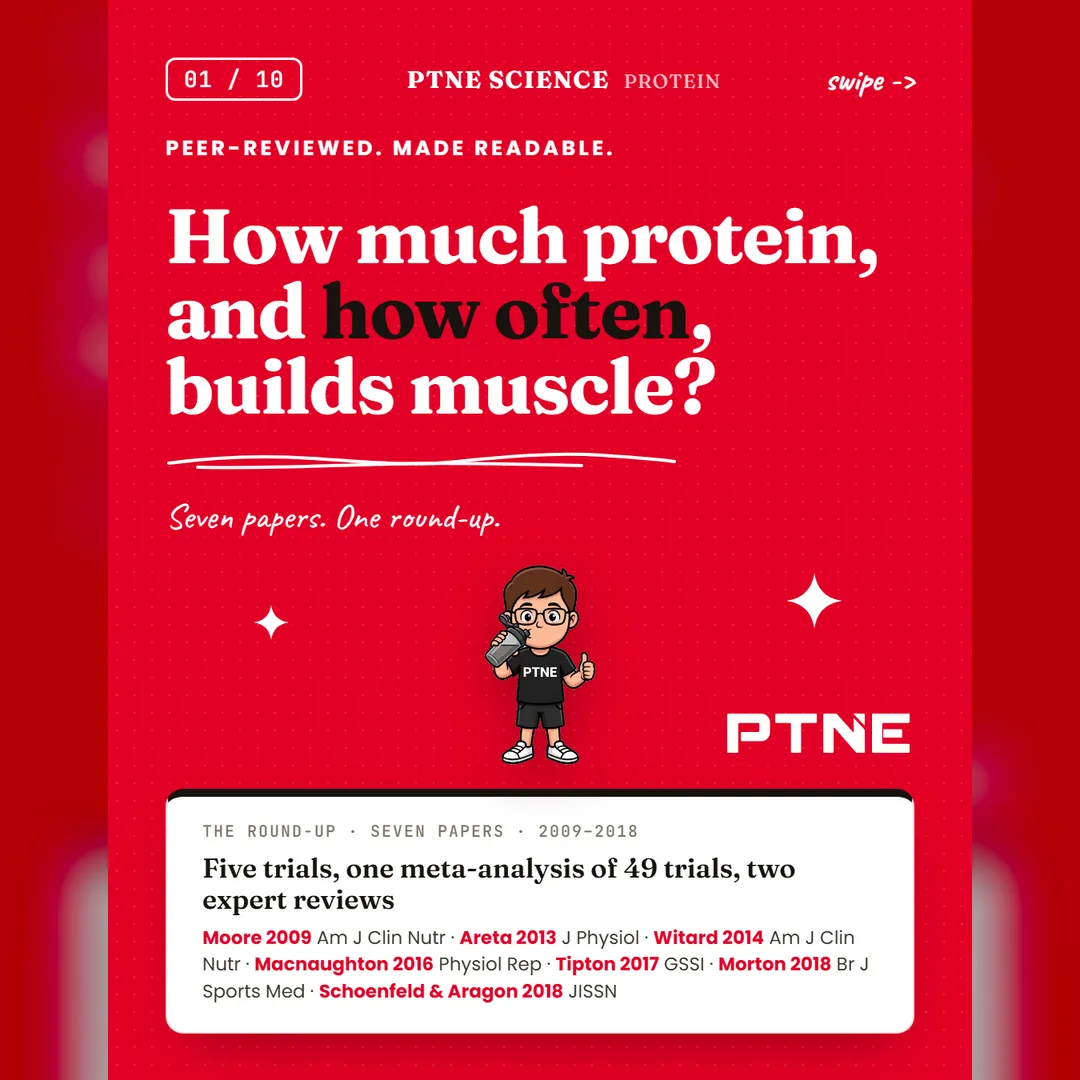
We ran the short version of this as a carousel on Instagram and Facebook first (Science Series, part three). This is the long version, because “eat more protein” isn’t actually the finding. If you missed part two, on how muscles actually grow, that’s the training half of this picture. This is the eating half.
Right, science time: how much protein to build muscle, according to the trials
This isn’t one paper. It’s a run of them, mostly out of Stuart Phillips’s lab in Ontario, plus the meta-analysis that pulled the field together. Read them as a set and three separate questions get three separate answers.
Question one: how much protein in a single meal actually gets used?
Moore and colleagues fed six men 0, 5, 10, 20 or 40 g of egg protein after a leg workout, measuring how much got built into muscle. The finding was blunt: “MPS displayed a dose response to dietary protein ingestion and was maximally stimulated at 20 g” (Moore et al., 2009). Above that, leucine oxidation, the marker for protein being burned rather than used, rose sharply. In Lehman’s terms, the muscle took what it needed and burned the rest as fuel.
Tipton’s 2017 review puts the figure at “20–25 g of high-quality protein… sufficient to maximally stimulate MPS in healthy young males following leg-only resistance exercise,” then adds the catch: a single fixed number is “too simple” once the muscle mass trained, age or protein quality changes. He’s proved right twice over. Macnaughton and colleagues found 40 g beat 20 g after whole-body resistance exercise, and Witard and colleagues, testing 48 men on whey, found 20 g and 40 g both worked while 10 g did nothing. The 20 g figure holds up. It just only covers one meal.
Question two: what’s the ceiling for the whole day?
Morton and colleagues’ 2018 meta-analysis pooled 49 trials and 1,863 people, measuring what protein supplementation did over weeks of training, not hours. Protein added 0.30 kg of fat-free mass (95% CI 0.09–0.52) and 2.49 kg of one-rep-max strength (95% CI 0.64–4.33), both significant. Then the number that matters most here: “protein supplementation beyond total protein intakes of 1.62 g/kg/day resulted in no further RET-induced gains in FFM.” Roughly 1.6 g per kilogram of bodyweight per day is where the curve flattens.
Question three: does it matter how you spread it?
This is the one most people never ask. Areta and colleagues gave 24 trained men the same 80 g of whey over 12 hours’ recovery, in one of three patterns: eight lots of 10 g every 90 minutes, four lots of 20 g every three hours, or two lots of 40 g every six hours. Same total, different timing. “All ingestion protocols increased MPS above rest throughout 1–12 h recovery (88–148%, P<0.02), but [the four-lots pattern] elicited greater MPS than [the other two] (31–48%, P<0.02).” Areta’s own conclusion: “20 g of whey protein consumed every 3 h was superior to either PULSE or BOLUS feeding patterns.”
Schoenfeld and Aragon’s 2018 review ties the three questions together: “to maximize anabolism one should consume protein at a target intake of 0.4 g/kg/meal across a minimum of four meals in order to reach a minimum of 1.6 g/kg/day.”
(If the numbers alone are enough for you, skip to the nutshell. I won’t be offended.)
The washing line analogy
Picture your day’s protein like washing on a line.
Peg the whole lot out in one enormous, sodden sheet (two big doses) and it takes forever to dry, damp in the middle the whole time. Peg out a single sock every twenty minutes (eight tiny doses) and you’re out there all day achieving almost nothing per trip. Peg out four decent-sized items, evenly spaced, each with room to actually dry before the next goes up, and the whole lot’s done properly by teatime.
That’s Areta’s finding in one image. Not more washing on the line. Spacing what you’ve got so each load actually does its job.
Come back to that line every time someone tells you “just have a shake after training and you’re sorted.” One item on the line, however big, was never going to get the whole day’s washing dry.
A confession
I used to be the bloke necking a shake the second I racked the last plate, convinced that was the whole job done. It’s an easy trap, because it feels rigorous, specific, measurable. What I wasn’t doing was thinking about the other sixteen hours of the day, where the actual eating happened on autopilot, usually two meals, usually whatever was easiest. I had one number right and the other two nowhere near it.
It took reading trials like Areta’s to realise the shake was never the strategy. It was one peg on a washing line I’d otherwise left half empty.
What’s still not settled
NB — the “~20–25 g ceiling” isn’t fixed across every situation. Schoenfeld and Aragon’s review is explicit that it’s “specific to the provision of fast-digesting proteins without the addition of other macronutrients.” A slower-digesting protein or a mixed meal can shift it, though none of these papers say by how much.
There’s also a gap between what most trials measure and what people care about. Moore, Witard, Macnaughton and Areta all measure muscle protein synthesis over a few hours in a lab, a real marker but not the same thing as months of growth. Only Morton’s meta-analysis measures the longer-term outcome, and it tests daily supplementation, not meal timing.
Morton’s own meta-regression is worth sitting with too: the effect on fat-free mass fell with age (−0.01 kg per year, P=0.002) and was bigger in people already resistance-trained (+0.75 kg, P=0.03). None of these seven papers were run primarily on women or older adults. The average effect across 1,863 people isn’t automatically the effect for the person in front of you.
In a nutshell
- Per-meal ceiling sits around 20 g after leg-only training (Moore et al., 2009), rising towards 40 g after whole-body training (Macnaughton et al., 2016)
- Daily total plateaus around 1.6 g/kg bodyweight — more supplemental protein beyond that added no further fat-free mass in a meta-analysis of 49 trials and 1,863 people (Morton et al., 2018)
- Spreading it across at least four meals of roughly 0.4 g/kg each beats both very frequent small doses and two large ones (Areta et al., 2013; Schoenfeld & Aragon, 2018)
- A single post-workout shake answers one of three questions, not all three
- The “20 g ceiling” is specific to fast-digesting protein without other macronutrients alongside it, and the effect of extra protein shrinks with age
How does this relate to your PT qualification and the job?
This is exactly what the Level 3 Award in Nutrition for Physical Activity covers: protein requirements, dosing and meal distribution for clients who are actually training, not generic “eat more protein” advice. The nutrition unit of the Level 3 Diploma Practitioner in Personal Training covers applying that guidance to a real client’s programme, within scope.
That scope boundary matters more than the numbers. A PT can tell a client roughly how much protein to eat and how to spread it across the day. A PT cannot diagnose a deficiency or prescribe a medical diet. That line sits with a registered nutrition or dietetic professional, and a good qualification teaches you exactly where it falls.
On the gym floor, this changes what you say to a client: sizing the post-session serving to what they trained that day, coaching the day’s total towards roughly 1.6 g/kg, and spreading protein across at least four meals rather than leaving it to chance. An S&C coach applies the same evidence further up the chain, sizing servings up after a genuine whole-body session rather than using the same fixed number every time.
A client can Google “how much protein to build muscle” and get a hundred conflicting answers in ten seconds. What they’re paying a qualified coach for is someone who’s read past the headline number and can explain why it moves.
The plug, owned
If you want to explain the why behind the protein number, not just repeat it, that’s what the Level 3 Award in Nutrition for Physical Activity teaches, alongside the nutrition unit in the Level 3 Diploma Practitioner in Personal Training. Both are Ofqual-regulated, CIMSPA endorsed and certificated by Focus Awards, delivered 1-to-1 in a real gym anywhere in the UK, or online at roughly half the price, with 0% finance options available. How the study actually works is on how you study. Rather ask a real person first? Get in touch.
Sources
Moore DR, Robinson MJ, Fry JL, Tang JE, Glover EI, Wilkinson SB, Prior T, Tarnopolsky MA, Phillips SM. Ingested protein dose response of muscle and albumin protein synthesis after resistance exercise in young men. American Journal of Clinical Nutrition. 2009;89(1):161–168. doi:10.3945/ajcn.2008.26401
Morton RW, Murphy KT, McKellar SR, Schoenfeld BJ, Henselmans M, Helms E, Aragon AA, Devries MC, Banfield L, Krieger JW, Phillips SM. A systematic review, meta-analysis and meta-regression of the effect of protein supplementation on resistance training-induced gains in muscle mass and strength in healthy adults. British Journal of Sports Medicine. 2018;52(6):376–384. doi:10.1136/bjsports-2017-097608
Schoenfeld BJ, Aragon AA. How much protein can the body use in a single meal for muscle-building? Implications for daily protein distribution. Journal of the International Society of Sports Nutrition. 2018;15:10. doi:10.1186/s12970-018-0215-1
Areta JL, Burke LM, Ross ML, Camera DM, West DW, Broad EM, Jeacocke NA, Moore DR, Stellingwerff T, Phillips SM, Hawley JA, Coffey VG. Timing and distribution of protein ingestion during prolonged recovery from resistance exercise alters myofibrillar protein synthesis. Journal of Physiology. 2013;591(9):2319–2331. doi:10.1113/jphysiol.2012.244897
Tipton KD. Factors That Influence the Amount of Protein Necessary to Maximize the Anabolic Response of Muscle Following Resistance Exercise. Gatorade Sports Science Exchange #172, October 2017.
Witard OC, Jackman SR, Breen L, Smith K, Selby A, Tipton KD. Myofibrillar muscle protein synthesis rates subsequent to a meal in response to increasing doses of whey protein at rest and after resistance exercise. American Journal of Clinical Nutrition. 2014;99(1):86–95. doi:10.3945/ajcn.112.055517
Macnaughton LS, Wardle SL, Witard OC, McGlory C, Hamilton DL, Jeromson S, Lawrence CE, Wallis GA, Tipton KD. The response of muscle protein synthesis following whole-body resistance exercise is greater following 40 g than 20 g of ingested whey protein. Physiological Reports. 2016;4(15):e12893. doi:10.14814/phy2.12893
Yours,
Sam Bradbury — PT & Nutrition Education
ptne.co.uk
Written by Sam Bradbury · PT & Nutrition Education · The Science Series · All posts