

Sore the next day? Good session. Woke up fine? Wasted session, back to the drawing board.
Wrong.
That belief has been knocking about gyms for decades, and I still hear it from people who are otherwise switched on. The honest answer to how do muscles grow doesn’t involve soreness at all. It’s not even reliable evidence that anything useful happened. If you’ve spent years chasing the ache because you think it’s the mechanism, this one’s for you.
Who this is for
This is for anyone who trains, and anyone weighing up coaching other people through it. Know your mechanical tension from your metabolic stress already? Stick around, what’s changed since 2010 will surprise a fair few of you.
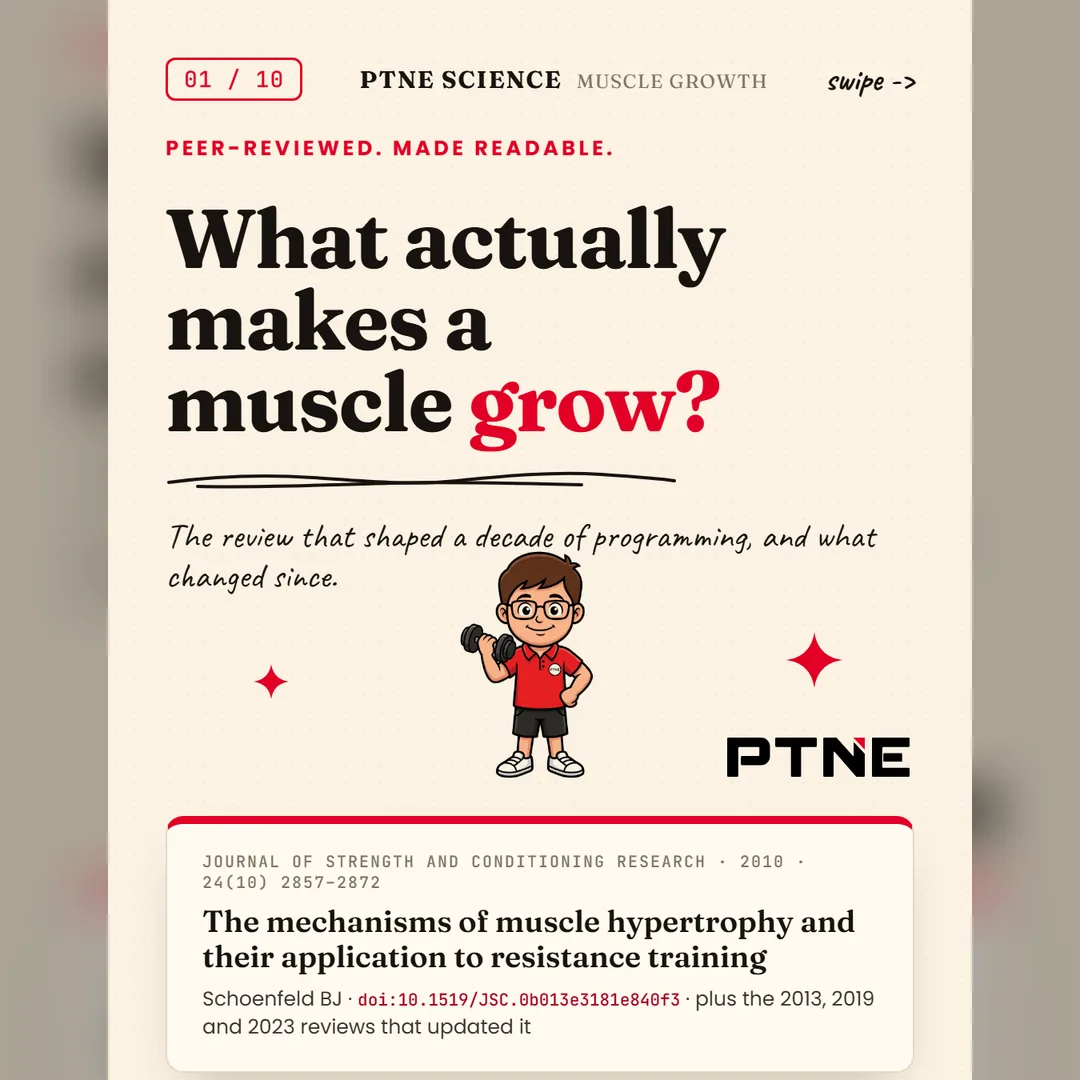
We ran the short version of this as a carousel on Instagram and Facebook first (Science Series, part two). This is the full version, for the bit that deserves more than a slide.
Right, science time: how do muscles grow
In 2010, Brad Schoenfeld published a review that’s shaped hypertrophy training ever since. He started from an odd puzzle: bodybuilders and powerlifters both build serious muscle, but train nothing alike. Bodybuilders use moderate loads, short rests, and finish sets swimming in metabolic stress. Powerlifters use heavy loads and long rests. Both are undeniably muscular. So which approach is doing the growing?
Schoenfeld’s answer: it isn’t one thing. It’s three.
1. Mechanical tension. The force the muscle fibre produces, and the stretch it’s put under while producing it. The review calls it essential: “mechanically induced tension produced both by force generation and stretch is considered essential to muscle growth, and the combination of these stimuli appears to have a pronounced additive effect” (Schoenfeld, 2010). Plain English: load the muscle properly, through a real range of motion, and you’re pulling the lever that matters.
2. Muscle damage. The micro-tears from training and the repair that follows. The 2010 review calls it a theory, not a certainty: “exercise training can result in localized damage to muscle tissue which, under certain conditions, is theorized to generate a hypertrophic response” (Schoenfeld, 2010). Plain English: damage might contribute, under the right conditions, but nobody was claiming it was the engine.
3. Metabolic stress. The burn. Metabolites piling up when rests are short. Again, the paper hedges: “although metabolic stress does not seem to be an essential component of muscular growth, a large body of evidence shows that it can have a significant hypertrophic effect, either in a primary or secondary manner” (Schoenfeld, 2010). Plain English: possibly helpful, not essential.
Three mechanisms, one paper, and a decade of gym-goers who read “metabolic stress” and decided that meant chase the pump at all costs.
(If you’re not fussed about the mechanism and just want the training template, skip to the prescription section below. I’m not offended.)
What the later reviews changed
Here’s the bit that doesn’t make it onto most gym walls: Schoenfeld didn’t stop in 2010, and neither did the field.
By 2013, tension had been promoted. Schoenfeld’s follow-up review states plainly: “the prevailing body of research indicates that mechanical stress is the primary impetus for this adaptive response and studies show that mechanical stress alone can initiate anabolic signalling” (Schoenfeld, 2013). Metabolic stress was still in the conversation, proposed to work through “increased fibre recruitment, elevated systemic hormonal production, alterations in local myokines, heightened production of reactive oxygen species and cell swelling” (Schoenfeld, 2013). Notice the word proposed. This wasn’t proven, it was theorised.
By 2019, a review by Wackerhage and colleagues went further, naming tension the clear front-runner: “mechanical signals are the prime hypertrophy stimuli candidates” (Wackerhage et al., 2019). Muscle damage took a demotion: “while exercise-induced muscle damage is probably not essential for hypertrophy, it is still unclear whether and how such muscle damage could augment a hypertrophic response” (Wackerhage et al., 2019). Metabolic stress fared no better: “this is based on indirect evidence and metabolite candidates are poorly characterized” (Wackerhage et al., 2019).
Underneath all three sits the actual machinery doing the building. The 2019 review names “a mammalian target of rapamycin complex 1 (mTORC1)-mediated increase of muscle protein synthesis” as “the key, but not sole, mechanism by which resistance exercise causes muscle hypertrophy” (Wackerhage et al., 2019). By 2023, a review from Roberts and colleagues laid out the fuller cellular list: “enhanced mammalian/mechanistic target of rapamycin complex 1 (mTORC1) signaling, an expansion in translational capacity through ribosome biogenesis, increased satellite cell abundance and myonuclear accretion, and postexercise elevations in muscle protein synthesis rates” (Roberts et al., 2023).
In Lehman’s terms: a muscle grows when the signal to build protein outruns the signal to break it down. Whatever sends that signal, the machinery underneath is the same: mTORC1 signalling, more ribosomes to build with, satellite cells adding nuclei, and a rise in protein synthesis after training. Tension is the lever the reviews keep coming back to. Soreness is probably not required, and the burn might help, but the evidence for it is indirect.
The building-site analogy
Picture a building site.
Tension is the foreman saying “we’re extending this wall, load-bearing, proper foundations, get it done.” That instruction is what gets the extension built. Without it, nothing happens, however busy the site looks.
Damage is the skip full of rubble from knocking the old wall out. Normal part of the job. It doesn’t build anything on its own, and a fuller skip doesn’t mean a bigger extension, just a messier one.
Metabolic stress is the noise, the mess, the brew breaks: the atmosphere of a hard graft. It might make the workers feel something serious is happening. It isn’t the foreman’s instruction, and it never was.
Chase the noise (soreness, the burn) and you can end up with a demolished wall and no extension. Follow the foreman’s instruction (real load, real range, done consistently) and the extension gets built whether the site was tidy or not.
The 2010 prescription, as a template not a law
Schoenfeld’s paper didn’t just describe mechanisms, it turned them into a training template. Verbatim from the Practical Applications section: “a hypertrophy-oriented program should employ a repetition range of 6–12 reps per set with rest intervals of 60–90 seconds between sets. Exercises should be varied in a multiplanar, multiangled fashion… Multiple sets should be employed in the context of a split training routine… At least some of the sets should be carried out to the point of concentric muscular failure, perhaps alternating microcycles of sets to failure with those not performed to failure… Concentric repetitions should be performed at fast to moderate speeds (1–3 seconds) while eccentric repetitions should be performed at slightly slower speeds (2–4 seconds). Training should be periodized so that the hypertrophy phase culminates in a brief period of higher-volume overreaching followed by a taper” (Schoenfeld, 2010).
Genuinely useful starting template. Two things worth knowing before you treat it as gospel, though.
First, it’s a narrative review, not a meta-analysis: one expert reading the available research and joining the dots, not a pooled statistical answer. Not a knock on it, that’s just what the paper is, and exactly why the weightings moved later.
Second, that 2010 prescription leaned partly on the two mechanisms that later got demoted. Short rests and to-failure sets are in there largely because of the metabolic stress and damage argument. If damage really is “probably not essential” and the metabolite evidence really is “indirect” (Wackerhage et al., 2019), then the why behind some of those numbers is shakier than the numbers themselves. The reps and rest periods still hold up. The reasoning behind a couple of them has moved on.
Mechanisms explain why a muscle grows, not how much training it takes to grow it a given amount. That’s a separate question about volume, for another day.
A confession
I’ve been on the wrong end of this myself. Earlier in my own training, before I knew any of this properly, I did the classic thing: trained too hard, too often, no real structure, chasing soreness because I thought that was the point. I picked up a fair few tendon and joint niggles doing it, some I still notice now. Nobody explained mechanical tension versus metabolic stress to me. I worked it out the hard way, which is a slower, more expensive way to learn something you could just be taught.
That’s most of why I care about teaching it properly now, rather than handing someone a rep-and-rest chart and calling it done.
In a nutshell
- A muscle grows through three proposed mechanisms: mechanical tension, muscle damage, and metabolic stress (Schoenfeld, 2010)
- Tension is now considered the primary driver (Schoenfeld, 2013; Wackerhage et al., 2019)
- Muscle damage is “probably not essential” for growth (Wackerhage et al., 2019)
- The evidence for metabolic stress as a stimulus is described as indirect (Wackerhage et al., 2019)
- Underneath it all: mTORC1 signalling, more ribosomes, satellite cells, and a rise in muscle protein synthesis (Wackerhage et al., 2019; Roberts et al., 2023)
- 6–12 reps and 60–90 seconds’ rest is a sound starting template (Schoenfeld, 2010), not a rule
- Soreness is not the goal, and it’s probably not required for growth
How does this relate to your PT qualification and the job?
This sits inside principles of training and programme design on the Level 3 Diploma Practitioner in Personal Training: why a variable works, not just which numbers go on a card. The Level 4 Certificate in Strength and Conditioning takes it further, into periodised programming for real athletes.
A PT who understands tension as the primary driver programmes differently to one just following a template: load and full range first, 6–12 reps and 60–90 seconds’ rest as a starting point rather than a rulebook, a deliberately controlled lowering phase (2010 recommends a slower eccentric). They stop selling soreness as proof the session worked, too, because the evidence for that link isn’t there.
An S&C coach applies the same understanding further up the chain: judging a programme by load progressed over weeks, not how wrecked an athlete feels the next day, periodising so tension keeps rising across a block rather than staying flat.
A client can find a rep-and-rest chart anywhere. What they’re paying a qualified coach for is someone who can explain why the chart says what it says, and change it properly when something isn’t working.
The plug, owned
If you want to understand this properly rather than just apply it, that’s what the Level 3 Diploma Practitioner in Personal Training and the Level 4 Certificate in Strength and Conditioning teach: the reasoning behind the numbers, not just the numbers. Both are Ofqual-regulated, CIMSPA endorsed and certificated by Focus Awards, delivered 1-to-1 in a real gym anywhere in the UK, or online at roughly half the price, with 0% finance options available. Full details of how the study actually works are on how you study. Rather ask a real person first? Get in touch.
Sources
Schoenfeld BJ. The mechanisms of muscle hypertrophy and their application to resistance training. Journal of Strength and Conditioning Research. 2010;24(10):2857–2872. doi:10.1519/JSC.0b013e3181e840f3
Schoenfeld BJ. Potential mechanisms for a role of metabolic stress in hypertrophic adaptations to resistance training. Sports Medicine. 2013;43(3):179–194. doi:10.1007/s40279-013-0017-1
Wackerhage H, Schoenfeld BJ, Hamilton DL, Lehti M, Hulmi JJ. Stimuli and sensors that initiate skeletal muscle hypertrophy following resistance exercise. Journal of Applied Physiology. 2019;126(1):30–43. doi:10.1152/japplphysiol.00685.2018
Roberts MD, McCarthy JJ, Hornberger TA, Phillips SM, Mackey AL, Nader GA, Boppart MD, Kavazis AN, Reidy PT, Ogasawara R, Libardi CA, Ugrinowitsch C, Booth FW, Esser KA. Mechanisms of mechanical overload-induced skeletal muscle hypertrophy: current understanding and future directions. Physiological Reviews. 2023;103(4):2679–2757. doi:10.1152/physrev.00039.2022
Yours,
Sam Bradbury — PT & Nutrition Education
ptne.co.uk
Written by Sam Bradbury · PT & Nutrition Education · The Science Series · All posts