

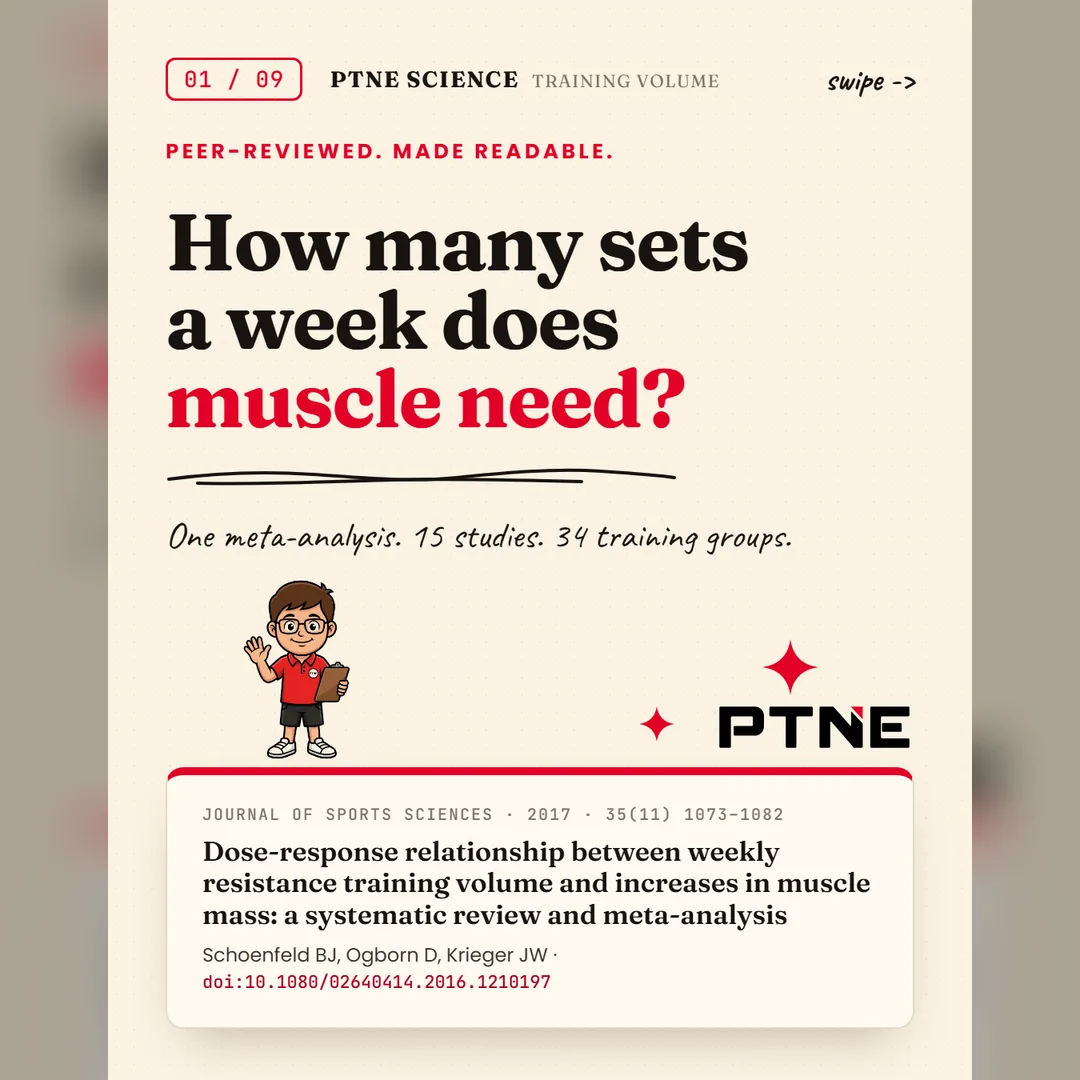
Three sets, job done. That’s what most people do for a muscle, once a week, and call it training.
It isn’t nothing. It’s just nowhere near enough, and the honest answer to how many sets a week does muscle need has been sitting in the research since 2017, largely ignored by the three-sets-and-done crowd.
Who this is for
This is for anyone training for size who has plateaued and can’t work out why, and for anyone weighing up coaching people through that problem for a living. Already programming ten-plus sets a muscle a week and periodising volume properly? You know most of this. Stick around for the caveats section, that’s where people usually go wrong.
We ran the short version of this as a carousel on Instagram and Facebook first (Science Series, part one). This is the full version, for the bit that deserves more than a slide.
Right, science time: what the paper actually did
In 2017, Brad Schoenfeld, Dan Ogborn and James Krieger published a meta-analysis in the Journal of Sports Sciences asking a blunt question: does more weekly training volume mean more muscle, and if so, how much more?
A meta-analysis is a study of studies. Instead of running one new experiment, the team gathered every published resistance training trial that tracked muscle size, pulled out the training groups, and analysed them together: fifteen studies, thirty-four training groups, all measuring sets per muscle per week against the change in muscle size that followed.
Two ways of asking the question, on the same data. Sets as a straight number: does each extra set nudge growth up? Sets grouped into low and high bands within each study: does the high-volume group in a trial out-grow the low-volume group in that same trial?
Sets as a number. “Outcomes for weekly sets as a continuous variable showed a significant effect of volume on changes in muscle size (P = 0.002). Each additional set was associated with an increase in effect size (ES) of 0.023 corresponding to an increase in the percentage gain by 0.37%” (Schoenfeld, Ogborn & Krieger, 2017). Plain English: every extra weekly set a muscle got was linked to roughly a third of a percent more growth over the study, and that pattern was strong enough to trust.
High volume versus low volume, within the same study. “Outcomes for weekly sets categorised as lower or higher within each study showed a significant effect of volume on changes in muscle size (P = 0.03); the ES difference between higher and lower volumes was 0.241, which equated to a percentage gain difference of 3.9%” (Schoenfeld, Ogborn & Krieger, 2017). Plain English: when a study compared a higher-volume group against a lower-volume group directly, the higher-volume group grew about four percent more.
The three-band split. The team also cut the data into under-5, 5-to-9, and 10-plus sets per muscle per week. “Outcomes for weekly sets as a three-level categorical variable (<5, 5–9 and 10+ per muscle) showed a trend for an effect of weekly sets (P = 0.074)” (Schoenfeld, Ogborn & Krieger, 2017). Ten-plus was the band that came out on top. That word trend matters, and I’ll come back to it.
Put the three together and the paper’s own conclusion is: “the findings indicate a graded dose-response relationship whereby increases in RT volume produce greater gains in muscle hypertrophy” (Schoenfeld, Ogborn & Krieger, 2017). More sets, more growth, in a graded line rather than a light-switch.
(If you just want the number to apply on Monday, skip to “In a nutshell” below. I won’t hold it against you.)
The allotment analogy
Picture a muscle like a vegetable patch, and a set like a spadeful of compost.
One spadeful does something. The soil’s slightly better than it was. But nobody grows a decent crop of anything off one spadeful a week, and that’s roughly where three sets sits.
Keep adding spadefuls and the bed keeps improving, a bit more each time, right up towards ten a week. That’s the graded line in the data: not one magic spadeful that switches growth on, a curve that climbs as you add more.
Here’s the bit people skip. Tip a barrow-load on in one go and you don’t get a barrow-load of extra growth. You get compost the plant can’t use, sat there rotting, because the roots can only take up so much at once. That’s volume outrunning recovery. More sets only helps as long as the muscle can absorb them.
The caveats: read this bit properly
1. The three-band split was a trend, not a cut-off. P = 0.074 misses the conventional line for statistical significance (0.05). The per-set finding (P = 0.002) and the high-versus-low finding (P = 0.03) are the solid results. “Ten-plus sets is best” is the authors’ practical reading of a pattern that leaned that way without quite clearing the bar on its own. Treat ten as a strong steer, not gospel carved in stone.
2. The analysis counts sets. It says nothing about how hard each one was. Three sets taken to genuine failure and ten sets that stop three reps short of anything are not the same stimulus, and this meta-analysis can’t tell you which client is doing which. Set count is the dose the paper measured. Effort is a variable it didn’t.
3. More is not free. Recovery has to keep up with volume, or the extra sets stop being extra growth and start being extra fatigue. Progress volume. Don’t jump it.
NB — this paper is about muscle size, not strength, not fat loss, not general fitness. Don’t borrow its numbers for a goal it wasn’t measuring.
A confession
Early in my own training I did the opposite of three-sets-and-done: stacked volume onto volume, more sets, more exercises, more sessions, on the logic that if some was good, more had to be better.
It wasn’t. Recovery never caught up, progress stalled for months at a time, and I picked up niggles that had nothing to do with how hard I trained and everything to do with how badly I managed the dose. Nobody explained that volume climbs a curve, not a cliff edge, and that the curve has a top. I found the top the hard way, well past where I needed to stop.
That’s the job now: teaching someone the curve before they go and find the edge of it themselves.
In a nutshell
- Weekly sets per muscle showed a graded dose-response relationship with muscle growth (Schoenfeld, Ogborn & Krieger, 2017)
- Every additional weekly set was linked to about 0.37% more growth (P = 0.002)
- Higher-volume groups grew about 3.9% more than lower-volume groups in the same study (P = 0.03)
- Ten-plus sets per muscle per week was the top band, though that specific split was a trend (P = 0.074), not a hard cut-off
- The paper counts sets, not effort, and recovery has to keep up
- Count sets per muscle per week, not per session, and nudge a low number up gradually
How does this relate to your PT qualification and the job?
Training volume sits inside programme design on the Level 3 Diploma Practitioner in Personal Training, specifically the unit on programming personal training with clients: not just which exercises go on a plan, but how much of each one, and why that number changes over time. The Level 4 Certificate in Strength and Conditioning goes further, into periodising volume across a training block for a real athlete.
A working PT applies this by auditing weekly sets per muscle rather than judging a session on how tired someone looks walking out. If a client’s shoulders are sitting on four sets a week spread across two sessions, that’s the bottom of the curve, and there’s room to nudge it up, a set or two at a time, then reassess at around eight weeks rather than guessing week to week.
An S&C coach applies the same idea further up the chain: programming volume in blocks, building towards a higher-volume phase deliberately rather than by accident, and watching an athlete’s recovery markers as closely as the numbers on the card.
A client can find “do more sets” written on a forum for free. What they’re paying a qualified coach for is someone who knows where their sets currently sit, how far up the curve they can safely go, and when to stop pushing volume and let recovery catch up instead.
The plug, owned
If you want to understand why a training programme says what it says, not just deliver the sets on the page, that’s what the Level 3 Diploma Practitioner in Personal Training and the Level 4 Certificate in Strength and Conditioning teach. Both are Ofqual-regulated, CIMSPA endorsed and certificated by Focus Awards, delivered 1-to-1 in a real gym anywhere in the UK, or online at roughly half the price, with 0% finance options available. Full details of how the study actually works are on how you study. Rather ask a real person first? Get in touch.
Sources
Schoenfeld BJ, Ogborn D, Krieger JW. Dose-response relationship between weekly resistance training volume and increases in muscle mass: a systematic review and meta-analysis. Journal of Sports Sciences. 2017;35(11):1073-1082. doi:10.1080/02640414.2016.1210197
Yours,
Sam Bradbury — PT & Nutrition Education
ptne.co.uk
Written by Sam Bradbury · PT & Nutrition Education · The Science Series · All posts