

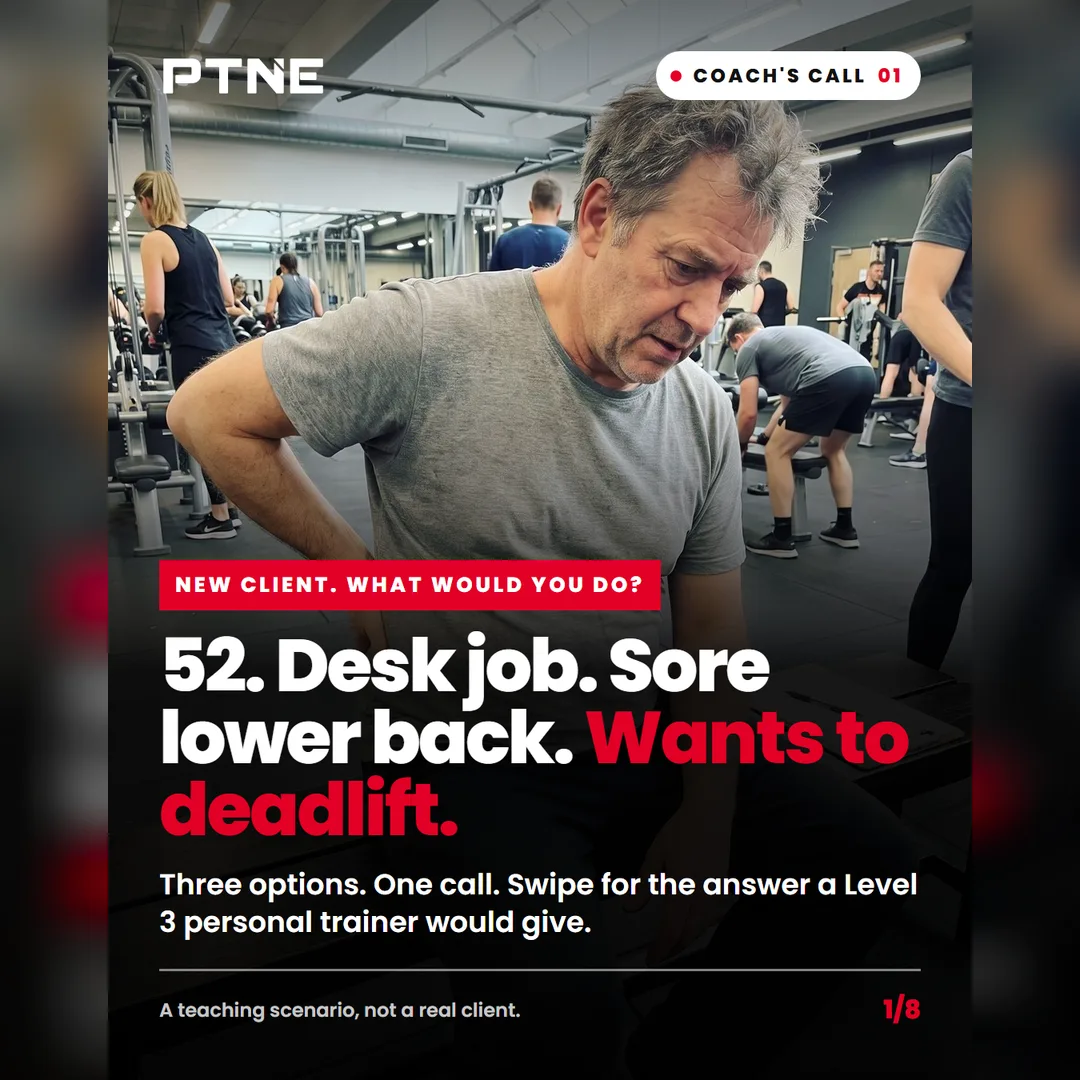
Sore back? Then no deadlifts. That’s the rule most people carry around, and plenty of new trainers too, without ever checking where it came from.
So, can you deadlift with lower back pain? Sometimes, yes. But “sometimes” is the whole job, and it’s the bit a Level 3 personal trainer is trained to get right.
Who this is for
This is for anyone thinking about coaching people for a living, and for anyone already doing it who has frozen when a client said “my back’s a bit sore, but I want to deadlift”.
If YOU have a sore back yourself, this is not medical advice. See your GP or a physiotherapist. What follows is how a trainer thinks, not a treatment plan.
We ran this as Coach’s Call 01 on Instagram and Facebook first. This is the full walk-through.
The scenario (and it IS a scenario)
Let’s be clear: the client below is made up. He’s a teaching example, not a real person, and the image on the carousel was AI-generated and labelled as such.
Here’s the brief. A new client, 52, desk-based job. His lower back aches by Friday. No pain or numbness down the leg. Screening is done and nothing in it needs a referral. His goal, in his words: “I want to deadlift.”
Three options.
A. No deadlifts. Too risky with a sore back.
B. Barbell from the floor in week one. It’s what he asked for.
C. Teach the hinge first, then load it in stages.
Pick one before you read on.
The call: C
Teach the hinge. Then load it in stages.
“But A is the safe option…” Well YES, if safe means doing nothing. Which brings us to the science bit.
Right, science time: why not A, and why not B
Why not A. The NICE guideline on low back pain and sciatica in over 16s (NG59) recommends encouraging people to continue with their normal activities, and offering exercise programmes as part of care. Telling a 52-year-old with an achy desk-job back to stop lifting runs against that steer. It also runs against the one thing he came for. A client told “no” to his only goal usually doesn’t stay a client, and he goes home and does nothing at all.
Why not B. He hasn’t shown you he can hinge yet. A barbell on the floor in week one is a big load on a movement you’ve never watched him do. That’s too much, too soon, however good his intentions.
In plain English: A is too little, B is too much, and C is the dose that fits him today.
(If you just want the staircase, skip to “What C looks like”. I won’t mind.)
The learner driver analogy
Think of a learner driver. You don’t ban them from driving because the M60 is scary. You also don’t hand them the keys at 8am on a Monday and say “good luck at the Trafford Park roundabout”.
You start in an empty car park. Then quiet roads. Then dual carriageways. Each step is bigger than the last, but only once the one before it is properly sorted.
Deadlifting is the same. The barbell is the motorway. The hinge is the car park.
What C looks like
Here’s an example. NB: an example, not a prescription. A real client’s plan comes from their own consultation and screening.
1. Own the hinge. Dowel drill, bodyweight only. Hips back, back flat, the movement learned before anything is loaded.
2. Load it high. A kettlebell lifted from a raised block, so the range is short and the demand is small.
3. Earn the bar. Romanian deadlifts first, then the bar from the floor, once the pattern stays solid under load.
The plan moves up a step when the last one is comfortable and repeatable, not when the calendar says so. If a step provokes his back, you hold or drop back. You don’t push through. Technique, technique, technique.
When it’s NOT your call
This is where a personal trainer stops being the right person. Refer on when you see:
- Pain travelling down a leg
- Pain at night
- Anything in screening that raises a flag
You don’t diagnose. You refer, to a GP or a physiotherapist, and you pick the programme back up with their say-so. Our scenario client passed screening cleanly, which is the only reason option C was on the table at all.
Knowing where your job ends is part of the job.
A confession
I’ve been the lad who ignored the warning signs. Years of heavy training left me with a list of tendon and joint niggles, some of which I still manage now. I learnt the hard way that load has to be built, not just piled on.
I wasn’t short of enthusiasm. I was short of a sensible dose. A good coach is the person who supplies one.
In a nutshell
- “Sore back means no deadlifts” is a reflex, not a plan
- NICE NG59 points towards staying active and exercise programmes for low back pain
- Teach the hinge first, load it high, then earn the bar
- Progress when a step is repeatable, hold or regress when it isn’t
- Pain down a leg, pain at night or a screening flag means refer on, don’t diagnose
- This scenario is a teaching example, never a real client
How does this relate to your PT qualification and the job?
Every step of this call sits in the Level 3 Certificate in Planning and Delivering Personal Training: consulting with a client about their history and goals, screening before you programme, then programming personal training with clients and delivering the sessions.
In the job, it looks like this. The consultation tells you he’s 52, desk-bound and sore by Friday. Screening tells you whether to carry on or refer. The programme is the staircase above, adjusted session by session. The delivery is coaching the hinge in the room: watching it, correcting it, and deciding when the next step is earned.
The same thinking runs through the Level 3 Diploma Practitioner in Personal Training, which combines the Level 2 and Level 3 for people starting from scratch.
A client can find “how to hip hinge” online for nothing. What he pays a coach for is the call: which option, when to progress, when to stop and send him elsewhere.
The plug, owned
PLUG ALERT. If that’s the job you want, the Level 3 Certificate in Planning and Delivering Personal Training and the Level 3 Diploma Practitioner in Personal Training teach it. Both are Ofqual-regulated, CIMSPA endorsed and certificated by Focus Awards, delivered 1-to-1 in a real gym anywhere in the UK, with 0% finance options. Curious how it works day to day? See how you study. Rather talk to a person? Get in touch. Want more on programming? Try how many sets a week for muscle growth.
Sources
National Institute for Health and Care Excellence. Low back pain and sciatica in over 16s: assessment and management (NICE guideline NG59). nice.org.uk/guidance/ng59
Yours,
Sam Bradbury, PTNE
ptne.co.uk
Written by Sam Bradbury · PT & Nutrition Education · Coach's Call · All posts