

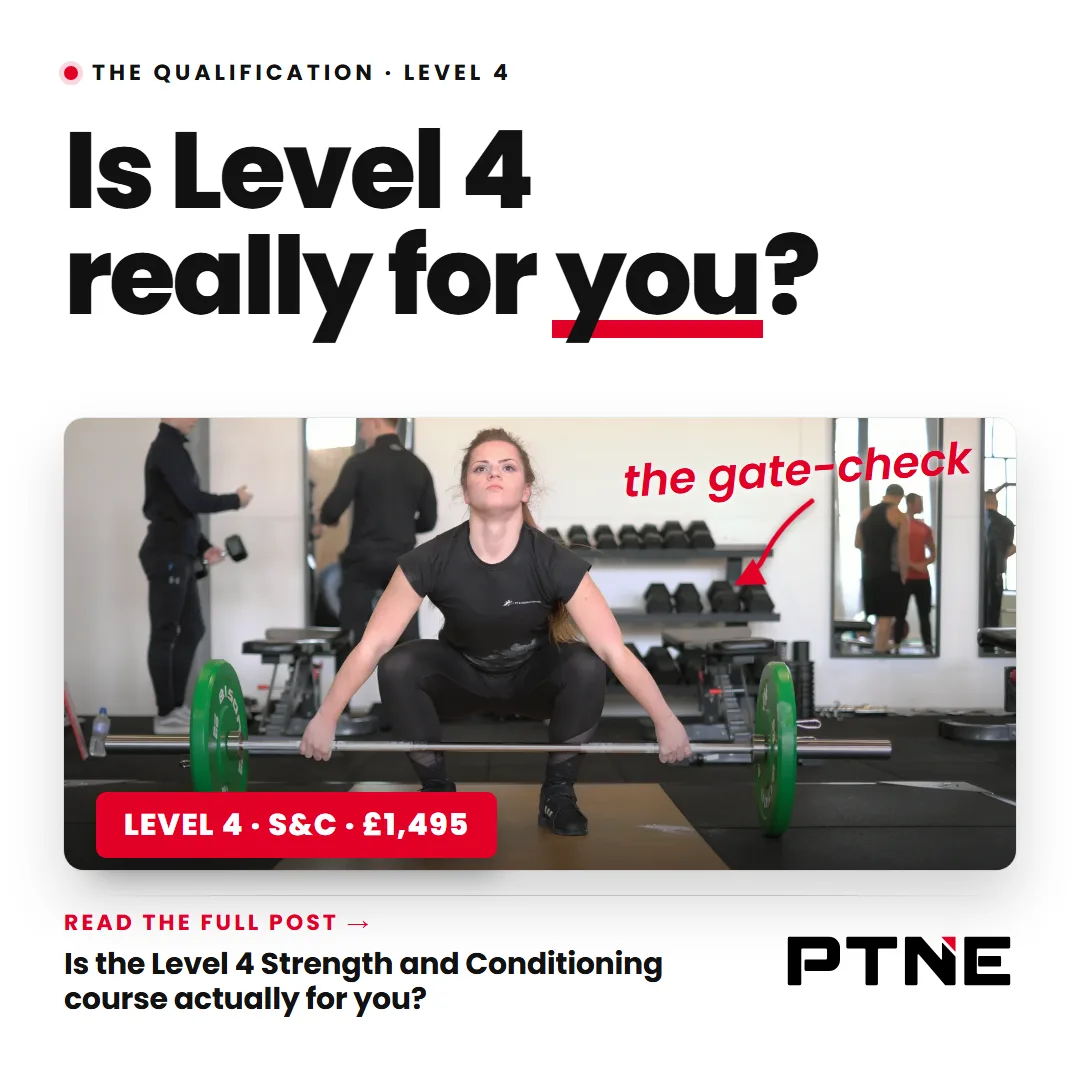
Level 4 Strength and Conditioning. Sounds like the one you buy once you’ve basically finished learning, right? A shinier badge for a bio that already says Personal Trainer.
Wrong. If that’s genuinely what you’re picturing, the Level 4 Strength and Conditioning course is about to be a short, expensive lesson in how different it actually is.
This isn’t a Level 3 with extra reading bolted on. It’s a different question aimed at a different kind of coaching, and it’s worth knowing that before you enquire, not after.
Who the Level 4 Strength and Conditioning course is actually for
This is for a working Level 3 personal trainer who has hit a wall with one particular type of client: the one who doesn’t just want to feel fitter, they want to run faster, jump higher, or recover from a hard match quicker than general programming is getting them. If that question has landed on you mid-session and you didn’t have a confident answer, keep reading.
It’s also for a Level 3 coach, a PE teacher, a physiotherapist or an osteopath, all named specifically as accepted entry routes, who already works around sport and wants the qualification that formalises it.
NB - this one has a real entry bar, stated plainly: a Level 3 Diploma Practitioner in Personal Training, a Level 3 coaching qualification, a Level 3 Strength and Conditioning qualification (or an equivalent), or a relevant higher or further education qualification such as physiotherapy or sports therapy, plus communication skills at Level 3. If you’re newly Level 2 and wondering whether you can skip straight here, you can’t. I’ve written separately about working out whether gym instructor or personal trainer is the right next step for you if that’s actually where you are.
Right, science time
Promise this is the short version. Skip to the next bit if principles bore you, I won’t tell anyone.
There’s a rule that underpins all of this, and it has a proper name: the SAID principle, Specific Adaptation to Imposed Demand. It states that your body adapts specifically to the actual demand you place on it, not to exercise in general.
In plain English: lifting weights makes you better at lifting weights, and fitter as a general human. It does not automatically make you faster off your left foot, better at repeating sprints every ninety seconds for ninety minutes, or more resilient through a change of direction. Those are specific demands, and closing that exact gap, between general fitness and a specific sporting outcome, is what Level 4 is built to teach.
Your GP, and the consultant down the corridor
Picture your GP, next to a consultant you get referred to.
A good GP sorts most of what walks through the door: a sprain, a chest infection, dodgy sleep, a lifestyle nudge in the right direction. That’s most of what a Level 3 personal trainer does too. Most clients, most of the time, want to be fitter, leaner, stronger and moving better, and general programming done well gets them there.
Then something specific turns up. A particular problem that needs its own test, its own protocol, built around that one thing. The GP refers you on, to someone who runs the right assessment, builds a plan specific to the problem, and can stand behind that plan in a meeting most patients never see, the one where the specialists compare notes and ask each other why, not just what.
Level 4 Strength and Conditioning is the referral. It’s coaching built around one specific performance outcome, against a real competitive clock, not a general health upgrade. Hold onto that meeting down the corridor. PTNE builds a version of it straight into the assessment itself.
What’s actually different about the Level 4 Strength and Conditioning course
Four things, and none of them are “more of Level 3.”
1. You programme for one real athlete, not a case study on paper. The programme is periodised, meaning the training emphasis shifts deliberately in blocks across weeks, built for a real person working towards a real competitive date, not a generic eight-week template.
2. You present it, then you defend it. The case-study programme goes in front of a panel of PTNE strength and conditioning experts, who ask why you built it that way, not just what’s in it. That’s your version of the meeting down the corridor.
3. The technical lifts are assessed directly. A high-bar back squat and one Olympic lift, coached and performed under assessment, not described in an essay about them.
4. The coaching unit tests you live. A warm-up, a speed and agility drill and a plyometric drill, delivered to a real person while someone is watching and marking it.
A confession
Early in my own coaching, before I’d gone anywhere near a proper strength and conditioning qualification, a client who played Sunday league football asked me to get him faster for the new season.
I gave him more of what was already working for his general fitness: heavier lifts, harder conditioning, the same toolbox turned up a notch. He got fitter. He didn’t get noticeably faster where it actually counted on a pitch, the first five yards, the change of direction, recovering between sprints. I’d trained the general case and called it the specific answer, because at the time I didn’t properly understand there was a difference worth naming.
In a nutshell
- The Level 4 Strength and Conditioning course isn’t a fancier Level 3, it’s a different question: a specific performance outcome, not general fitness
- The entry bar is real: a Level 3 Diploma Practitioner in Personal Training, a Level 3 coaching or Strength and Conditioning qualification, or an equivalent like physiotherapy or sports therapy, plus Level 3 communication skills
- You programme, present and defend a periodised plan for a real athlete, in front of a panel
- The technical lifts (a high-bar back squat and one Olympic lift) and a live coaching unit are both assessed directly, not written about
- No invented job or income promises here, just what the qualification actually is and who it’s actually for
The plug, owned
If you’re already coaching and this sounds like your client problem, the Level 4 Certificate in Strength and Conditioning is Ofqual-regulated, CIMSPA endorsed and certificated by Focus Awards, £1,495 traditional delivery (online also available), with 0% finance options either way.
If you’re not there yet, the direct routes in are the Level 3 Diploma Practitioner in Personal Training or the Level 3 Certificate in Planning and Delivering Personal Training. Curious how the study itself actually works? See how you study. Or get in touch and I’ll tell you honestly whether you’re ready for this one yet.
Yours,
Sam Bradbury — PT & Nutrition Education
ptne.co.uk
Written by Sam Bradbury · PT & Nutrition Education · All posts