

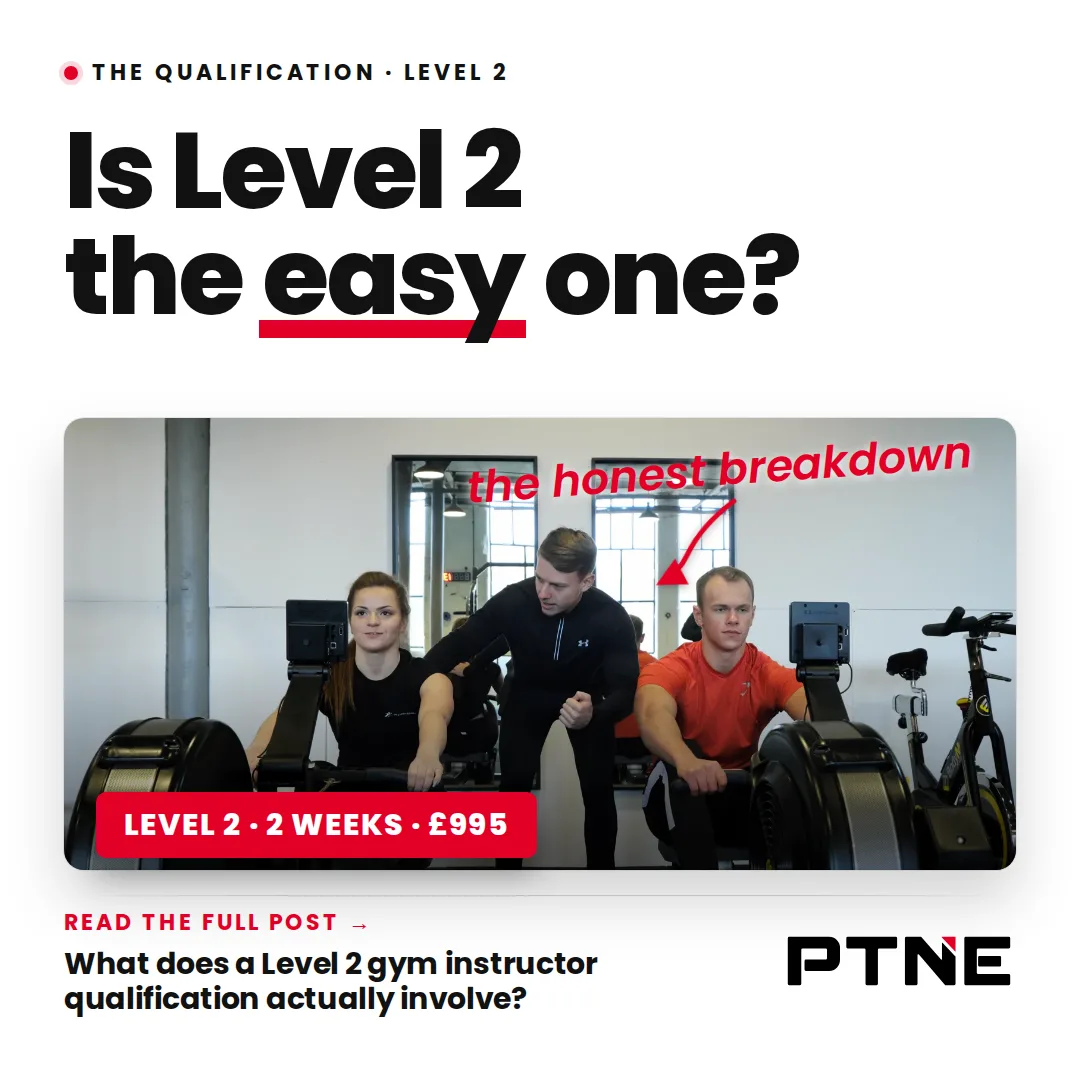
What does a Level 2 gym instructor qualification actually involve? Ask most people considering fitness as a career and they’ll guess the same thing: the easy one. The stepping stone you tick off quickly so you can get on with becoming an actual personal trainer.
Wrong. Or at least, wrong about the “easy” bit.
The Level 2 Certificate in Planning and Delivering Gym Based Exercise is six units, two of them exams, and it ends with a practical exam in front of a real, working client. Nobody hands you that badge for turning up and nodding along. It’s the foundation every other qualification PTNE offers is built on, and foundations don’t get to be flimsy.
Who this is for
This is for anyone weighing up whether “gym instructor” is a real two-week commitment or a watered-down starter badge, before they commit any money to finding out.
If you’ve already got your sights set on personal training and you’re wondering whether you can skip straight there, I’ll save you the suspense: no. The Level 3 Certificate in Planning and Delivering Personal Training requires the Level 2 first, because everything in it assumes you can already run a session safely. There’s no shortcut version where you jump the queue. (If you want the fuller picture of how the two actually differ once you’re qualified, I’ve written that one up separately.)
Right, science time
Here’s the one proper bit of theory the Level 2 actually tests, and it’s worth knowing before you assume the whole thing is folding towels and pointing at machines.
Every programme you’ll ever write, for anyone, rests on one principle: the body only adapts to the specific demand you place on it, and only if that demand is enough to disrupt it a bit. Exercise scientists call the “enough to disrupt it” part progressive overload. Give someone the same ten minutes on the same bike at the same resistance every single week, and their body stops noticing. It’s already coped. Nothing to adapt to.
In plain English: if you don’t nudge something — weight, reps, pace, rest — your client plateaus, and it’s your fault, not theirs. That’s the actual exam question hiding inside “planning gym-based exercise”: why this one, now, for this person, and what changes next week.
(If you’ve already done any proper training yourself, you’ve felt this without naming it. Skip ahead, you’re not missing anything new.)
The lifeguard, not the swim coach
Think about anyone who’s ever done a lifeguard course.
A lifeguard watches the whole pool. Every lane, every age, every ability, all at once. They’re trained to spot trouble early, react properly, and run that pool safely for everyone in it on any given Tuesday. What a lifeguard doesn’t do is take one swimmer aside for six weeks and rebuild their stroke technique from the ground up. That’s a different job, with a different name and a different fee attached: a swim coach.
The Level 2 Certificate in Planning and Delivering Gym Based Exercise is the lifeguard badge. It licenses you to run the whole gym floor safely: inductions, group sessions, spotting the person about to drop a loaded bar on their own foot. The Level 3 Certificate in Planning and Delivering Personal Training is the swim coach: one client, one bespoke programme, run over a real eight-week case study, paid for directly.
Hold onto that. You don’t need the swim coach’s badge to be trusted with the whole pool. But you do need the lifeguard’s badge first, because nobody lets you coach one swimmer until you’ve proven you can keep everyone safe.
What a Level 2 gym instructor qualification actually involves
Six units, no padding:
- Anatomy and Physiology for Exercise — an exam. The body parts and systems you’re actually working with.
- Know how to support clients who take part in exercise and physical activity — file work, on the people skills side of the job.
- Health, safety and welfare in a fitness environment — file work, because a gym floor has genuine ways to go wrong.
- Principles of exercise, fitness and health — another exam, the “why this works” theory behind planning a session.
- Planning gym-based exercise — file work, building an actual session plan for an actual client.
- Instructing gym-based exercise — a practical exam, with a working client.
That last one is where the “easy badge” idea quietly falls apart.
The practical exam is the bit people don’t picture
Most people picture Level 2 as a classroom thing: sit, listen, answer some questions, done. Then they find out about unit six, and it lands differently.
You don’t write about delivering a session. You deliver one. A real person stands in front of you, on a real gym floor, and you have to induct them, instruct them and keep them safe, while someone assesses whether you actually did it, not whether you can describe doing it. There’s nowhere to hide behind good exam technique. Either the coaching works, in the room, or it doesn’t.
The entry bar, named plainly
There’s no formal entry requirement for the Level 2, which is good news if you’re starting from genuinely nothing. But “no formal entry requirement” isn’t the same as “no expectations.” Some gym experience, including free weights, is strongly recommended. The course involves real physical exertion, so you need a reasonable degree of fitness yourself. And you’ll need communication skills at Level 2 minimum, because half the job is talking to a nervous stranger about their body.
Honest version: anyone can start here. Not everyone sails through without putting the work in. Those are different sentences, and providers who only say the first one aren’t telling you the whole truth.
Where it actually takes you
Pass it, and you’ve got a direct pathway into gym instructor roles in the UK, standalone, a real job in its own right if that’s genuinely what you want. Plenty of people stop there on purpose.
It’s also the only route onto the Level 3 Certificate in Planning and Delivering Personal Training and, eventually, the Level 4 Certificate in Strength and Conditioning. I’m not going to promise you a wage the day you qualify, because nobody honest can, but the progression itself is real and it’s exactly in that order.
In a nutshell
- The Level 2 Certificate in Planning and Delivering Gym Based Exercise is six units, two exams, three pieces of file work, and a practical exam with a real client
- There’s no formal entry requirement, but gym experience and a reasonable level of fitness are strongly recommended
- The practical exam is the real differentiator: delivering a session, not writing about one
- It’s the only route into the Level 3 Certificate in Planning and Delivering Personal Training — no skipping it
- No invented job or income promises here, just what the qualification actually tests
The plug, owned
If this is genuinely where you’re starting, the Level 2 Certificate in Planning and Delivering Gym Based Exercise is Ofqual-regulated, CIMSPA endorsed and certificated by Focus Awards, £995 traditional delivery, taught 1-to-1 in a real gym anywhere in the UK, or online. 0% finance options are available either way.
Already know you want to go further? The natural next steps are the Level 3 Certificate in Planning and Delivering Personal Training or the Level 3 Diploma Practitioner in Personal Training, which combines Level 2 and Level 3 into one route. Curious how the study itself actually works? See how you study. Or just get in touch and ask me directly whether this is the right place to start.
Yours,
Sam Bradbury — PT & Nutrition Education
ptne.co.uk
Written by Sam Bradbury · PT & Nutrition Education · All posts