

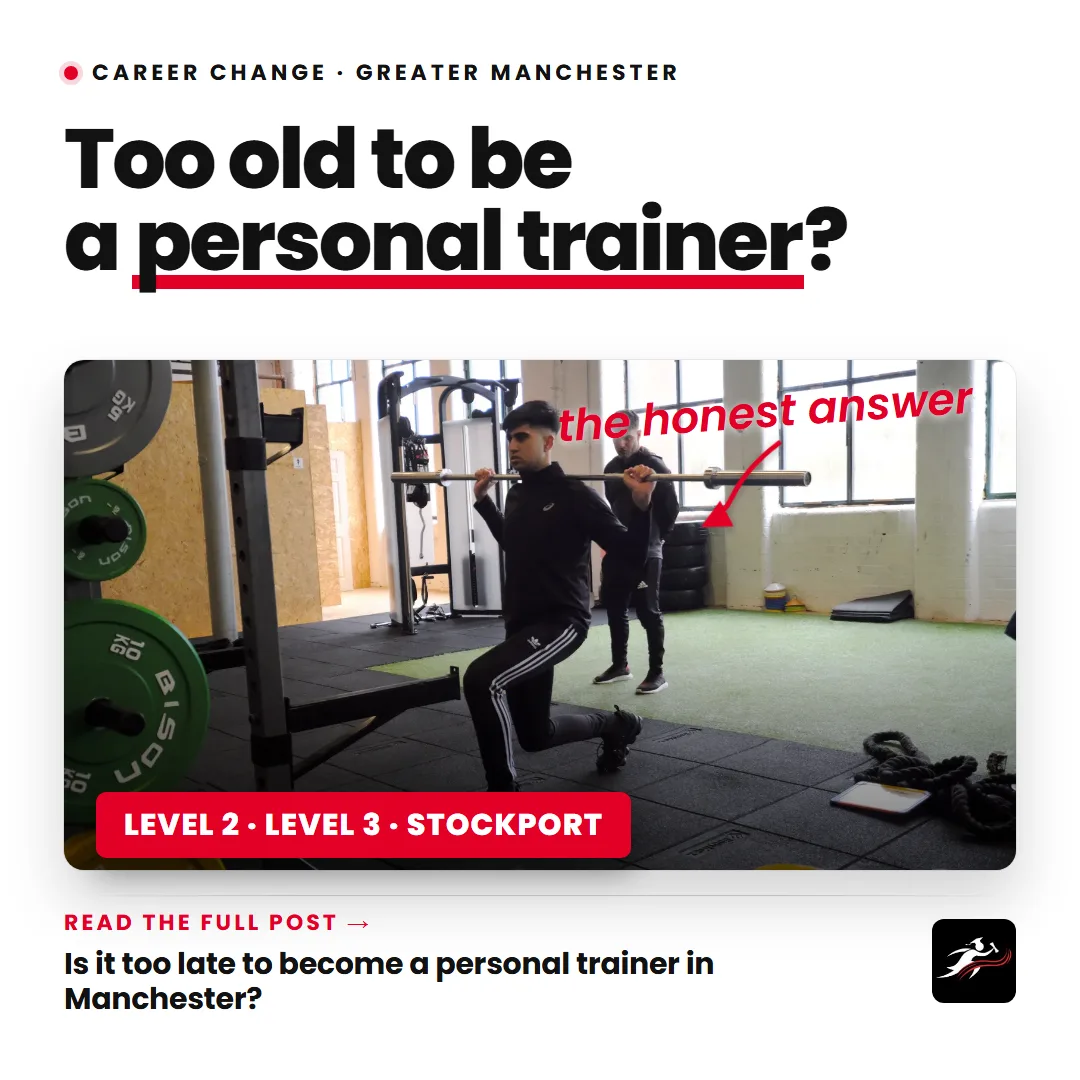
You’ll hear it in every gym car park in Stockport, usually said by someone lacing up trainers they bought three New Years ago: it’s too late for me now. Too old, too unfit, too far into a job they didn’t mean to still be in, too many years since they were “the sporty one” at school. So they carry on doing the job that pays the mortgage and coach nobody but themselves, quietly, before work.
Wrong.
I’ve taught people through the Level 2 Certificate in Planning and Delivering Gym Based Exercise and the Level 3 Certificate in Planning and Delivering Personal Training who started that course as a painter and decorator, as a warehouse picker, as someone eighteen months out of a completely different degree. Age wasn’t the thing that decided whether they made it through. It genuinely wasn’t the biggest factor in the room.
Who this is for
This is for the person in Greater Manchester, Stockport or the High Peak turning career change over in their head on the drive home. Twenties and wondering if they’ve drifted into the wrong job without ever choosing it. Thirties or forties and wondering if the window’s shut. Might have a family, a mortgage, a full-time job you can’t just walk out of tomorrow.
If you’re already a Level 2 gym instructor deciding whether to step up to Level 3, this isn’t really your article — read about what the Level 3 actually covers instead, because your question isn’t “am I too old”, it’s “am I ready”. And if you’re hoping someone will promise you a set wage the day you qualify, I can’t help with that either — nobody honest can, and you should be suspicious of anyone who says otherwise.
Right, let’s talk about what actually gets checked
Here’s the bit people skip over when they’re busy worrying about their age: nobody assessing you for a personal training qualification is assessing how young you look. The Level 2 is six units — two exams, three pieces of file work and a practical exam with a real client. The Level 3 builds on it with a case study run over a real eight-week period with an actual client, a portfolio, a practical demonstration, an assignment, more coursework and a multiple-choice exam. Every one of those is checking whether you can apply anatomy and physiology, plan a session properly, and coach a real human being safely in front of you. None of it is checking your date of birth.
(Skip this bit if you already know how quals work — the point’s coming either way.)
In plain terms: the qualification is built to test whether you can do the job, not whether you fit some picture of what a PT looks like. That’s not a marketing line, that’s just what’s actually on the syllabus.
The gym-membership test
Here’s the analogy I keep coming back to with career changers, because it lands every time.
Nobody stands in the doorway of a gym and tells a 45-year-old they’re too old to start training. Nobody’s ever done that to you, or to anyone you know. You just walk in, you start, and six months later you’re stronger than you were, full stop. Nobody re-litigates whether you had the right to begin.
So why does the same 45-year-old, stood in the exact same gym, suddenly need permission to coach it?
It’s the same building. Often the same floor. The only thing that’s changed is the story they’re telling themselves. If “too old to start training” is obviously nonsense to you when it’s someone else saying it about the gym floor, “too old to start coaching” is the same nonsense wearing a different jumper.
Four reasons age and career stage aren’t the obstacle you think
1. You’ve already got the one thing a nervous seventeen-year-old hasn’t. You know what it’s like to have a job you don’t love, a body that doesn’t cooperate first thing on a Monday, and a life that doesn’t leave three free hours a day to train. That’s not a disadvantage in front of a client who’s exactly the same. It’s the entire job.
2. The course is built around your week, not the other way round. 1-to-1 delivery in a partner gym anywhere in the UK means your tutor works to your schedule — evenings, weekends, whatever fits round the job you’ve currently got. Or you study online, entirely at your own pace, at roughly half the traditional price, if getting to a gym at a fixed time isn’t realistic for you right now.
3. “No sporting background” is not the same as “no chance.” I’ve had learners come through with zero background in organised sport who passed. What actually predicts whether someone gets through isn’t their PE-lesson history, it’s whether they turn up and do the reading.
4. The industry is big, and it’s short of people. CIMSPA’s 2023 Workforce Insights Report puts the UK sport and physical activity workforce at around 586,000 jobs as of 2022. It took a knock through the pandemic — roughly 26,000 fewer jobs than in 2019 — and the same report describes employers competing hard to fill their vacancies since. The bit that matters to you is narrower: fitness instructor jobs, which is where personal trainers sit, grew from roughly 28,000 in 2006 to almost 80,000 by 2019, up 175% in thirteen years. Read that the way a career changer should: a large trade that lost people and wants them back, not a crowded one with the doors shut.
A confession
I’ll be honest about my own route in, because it wasn’t some straight, tidy plan either. I spent years working across fitness, coaching and education before I founded PT & Nutrition Education in 2017 — there wasn’t a moment where I ticked a box marked “qualified enough” and the doubt switched off. And earlier in my own training, before any of that, I did the classic thing: trained too hard, too often, no proper structure, and picked up a fair few tendon and joint niggles I still notice now. Nobody warned me. I’m telling you instead.
[Sam: if there’s a specific moment — a client, a year, a gym — you’d rather use here than the general version above, tell me and I’ll swap it in. I’ve kept this to what’s already on record so nothing’s invented.]
The point isn’t the injuries. It’s that I didn’t arrive at this fully formed either. Nobody does. You learn the trade by starting it, at whatever age you happen to start it.
In a nutshell
- The Level 2 and Level 3 qualifications assess what you can do, not how old you are
- Career changers with no sporting background pass regularly — it’s not the deciding factor
- 1-to-1 delivery works around a full-time job; online works around anything
- The sector is around 586,000 jobs and employers are struggling to fill vacancies (CIMSPA, 2023) — big, and short of people
- The only real barrier is the one in your own head, and it’s the same one everyone has
The plug, owned
If you’re weighing this up seriously: the Level 3 Certificate in Planning and Delivering Personal Training is where most of our career changers land, usually after the Level 2 Certificate in Planning and Delivering Gym Based Exercise if they’re starting from nothing. Both are Ofqual-regulated, CIMSPA endorsed and certificated by Focus Awards, taught 1-to-1 in a real gym anywhere in the UK, or online at roughly half the price. Have a look at how you study and see which route actually fits your week, or just get in touch and ask me directly — including about our guaranteed job interviews on qualifying, which is a real thing we offer, not a line.
Yours, Sam Bradbury — PT & Nutrition Education ptne.co.uk
Written by Sam Bradbury · PT & Nutrition Education · All posts