

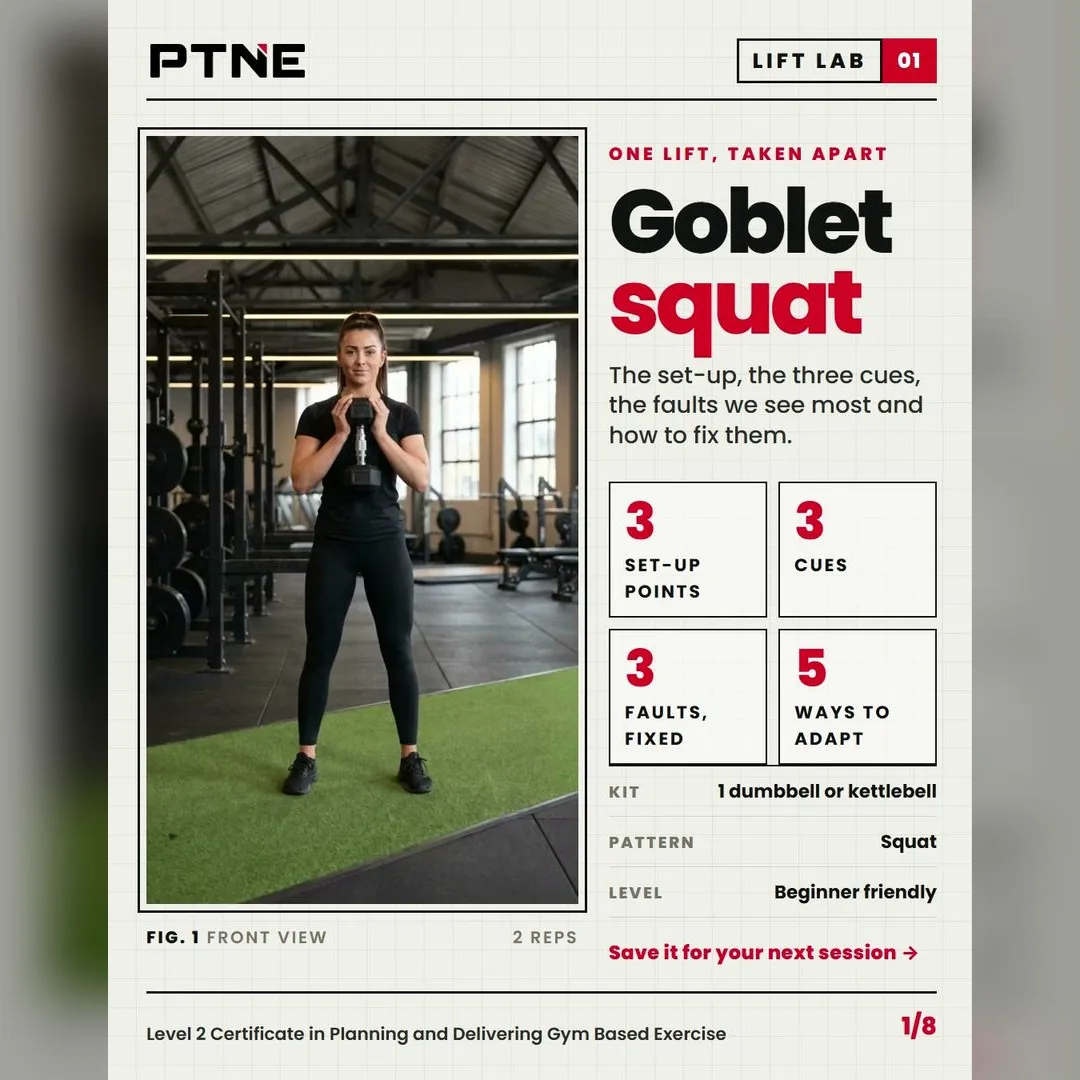
Hold a weight at your chest and sit down. Easy, right? Nothing to it.
Then you watch the knees cave in, the heels peel off the floor and the chest fold over like a deckchair. The goblet squat looks simple, which is exactly why so many people get it wrong, and why it’s such a good lift to learn how to coach.
Who this is for
This is for anyone who wants to know how to do a goblet squat properly, and for anyone thinking about coaching other people through it for a living. Already squatting well? Skip to the faults. That’s where the coaching is.
We ran the short version as a carousel on Instagram and Facebook first (Lift Lab 01). This is the full version, for the bits that deserve more than a slide.
What the goblet squat trains
The main movers are your quadriceps (front of the thigh), your gluteus maximus (your backside) and your adductors (inner thigh). They do the lifting.
Holding you steady are your trunk muscles, plus your upper back and arms, which keep the weight in place.
Right, science time! (Skip this bit if you like, I won’t be offended.) Every squat is a negotiation between those leg muscles driving you up and your trunk keeping everything stacked. Hold the weight out in front of you and the trunk has to work harder to stop you tipping forward. In plain English: the weight is a built-in coach, because it punishes a sloppy position straight away.
The shopping bag analogy
Picture carrying a heavy bag of shopping in from the car boot.
Hug it to your chest and you walk upright without thinking. Hold it out at arm’s length and it drags you forwards, your back rounds and your arms burn.
The goblet squat is the hug. Keep the weight tight to you and it counterbalances you, so your chest stays up and you can sit down into the squat rather than fall forwards into it. I’ll keep coming back to that bag.
How to do a goblet squat: the set-up
Get this right and the rep looks after itself. Three things.
1. Feet about shoulder-width apart. Toes turned out slightly, weight through the whole foot, not just the toes or the heels.
2. Weight tight to your chest. Held upright by the top, elbows pointing down. Elbows flaring out usually means the weight is drifting off you.
3. Breathe in and brace. Then move. Not before.
NB - “brace” doesn’t mean suck your belly in. Stiffen the whole trunk, like a belt pulled snug.
The three cues a coach actually says
You could fill a textbook with squat cues. A new client can take in about one at a time, so I keep it to three.
“Sit down between your heels.” Your hips drop between your feet, rather than back and behind you.
“Knees follow your toes.” They travel out over the feet, never in.
“Weight stays glued to you.” If it drifts away, the chest follows it down. Back to the shopping bag.
The faults we see most (and the fix for each)
Spot it, fix it. These three turn up in nearly every beginner session.
Knees caving in. The fix is a cue, not a lecture: “push the floor apart” with your feet on the way up.
Heels lifting. Weight back to mid-foot, and a shallower squat while ankle mobility improves. Don’t chase depth you haven’t earned yet.
Chest folding forward. Use a lighter weight, held higher and closer. Nine times out of ten the weight has wandered away from the body.
Make it easier, make it harder
A good coach meets the client where they are, rather than where the programme says they should be.
To make it easier, use a box squat, which sets the depth for them (the cue is “touch, don’t sit”), or drop the weight altogether and squat with bodyweight only.
To make it harder, slow the lowering down to three seconds, pause at the bottom for two, or move on to a barbell front squat as the next lift.
That’s five ways to adapt one exercise without changing what the client has already learned.
A confession
I’ve been the person who loaded a lift before the positions were earned. I’ve paid for it with niggles that took far too long to clear, and I learnt the hard way that ego adds weight faster than technique can carry it.
That’s why I like the goblet squat so much. It makes you earn the position first.
In a nutshell
- Feet about shoulder-width, toes slightly out, weight through the whole foot
- Weight tight to the chest, elbows down
- Breathe in and brace, then move
- Three cues: sit down between your heels, knees follow your toes, weight stays glued to you
- Knees caving: push the floor apart. Heels lifting: mid-foot, shallower squat. Chest folding: lighter weight, higher and closer
- Easier: box squat or bodyweight. Harder: slower lowering, a pause, or a barbell front squat
How does this relate to your PT qualification and the job?
The goblet squat sits inside the Level 2 Certificate in Planning and Delivering Gym Based Exercise. The anatomy behind it (which muscles move you and which hold you steady) is the Anatomy and Physiology for Exercise unit. How you choose and set it up for a person is the Planning gym-based exercise unit. Coaching it is the Instructing gym-based exercise unit, which is a practical exam with a working client.
That last one is the point. Knowing the three cues is one thing. Saying the right one, at the right moment, to a real person who’s nervous and whose knees are caving, is the skill the assessment looks for.
On the gym floor, a gym instructor does exactly this. You watch a member’s squat from the front and the side, pick the one fault that matters, give them one cue, and regress or progress the lift to suit them. The same habits carry straight on to the Level 3 Certificate in Planning and Delivering Personal Training, where you plan whole programmes around clients and their goals. Still working out which route suits you? I’ve written about gym instructor or personal trainer.
A client can find a goblet squat video for free. What they pay a coach for is someone who sees the fault, knows the fix and can change the lift on the spot.
The plug, owned
If you want to learn to coach lifts like this, that’s what the Level 2 Certificate in Planning and Delivering Gym Based Exercise is for. It’s Ofqual-regulated, CIMSPA endorsed and certificated by Focus Awards, delivered 1-to-1 with a tutor in a partner gym anywhere in the UK for £995, or online, with 0% finance options. Curious how the study works? See how you study. Rather talk to a real person first? Call 07837 575 920, email ask@ptne.co.uk or get in touch.
Yours,
Sam Bradbury, PTNE
ptne.co.uk
Written by Sam Bradbury · PT & Nutrition Education · Lift Lab · All posts